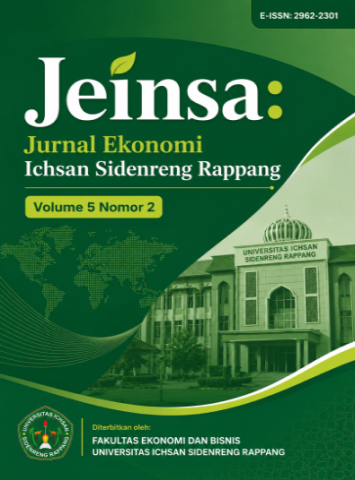
THE EFFECT OF DIGITAL COMPETENCE AND WORK DISCIPLINE ON EMPLOYEE PERFORMANCE THROUGH WORK MOTIVATION IN THE REGIONAL SECRETARIAT OF MERAUKE REGENCY
DOI:
https://doi.org/10.61912/jeinsa.v5i2.531Keywords:
Digital Competence, Work Discipline, Work Motivation, Employee PerformanceAbstract
Digital administration requires employees who can use technology effectively, follow procedures, and sustain work motivation. This study examines the effects of digital competence and work discipline on employee performance through work motivation in the Regional Secretariat of Merauke Regency. A quantitative explanatory survey with a cross-sectional design was conducted in June and July 2026. All 149 employees in the research population participated through a census. Data were collected using a twenty-item questionnaire with five response levels and analyzed using partial least squares structural equation modeling with SmartPLS 4. Digital competence and work discipline had positive and significant direct effects on performance, with coefficients of 0.257 and 0.244. Both predictors also positively influenced motivation, which positively influenced performance. Their indirect effects were 0.182 and 0.154, indicating complementary partial mediation. The model explained 43.0 percent of motivation variance and 50.2 percent of performance variance. The findings support digital collaboration training, clear task responsibilities, and recognition of employee contributions.
References
Becker, J.-M., Cheah, J.-H., Gholamzade, R., Ringle, C. M., & Sarstedt, M. (2023). PLS-SEM’s most wanted guidance. International Journal of Contemporary Hospitality Management, 35(1), 321–346. https://doi.org/10.1108/IJCHM-04-2022-0474
Bos-Nehles, A., Townsend, K., Cafferkey, K., & Trullen, J. (2023). Examining the ability, motivation and opportunity (AMO) framework in HRM research: Conceptualization, measurement and interactions. International Journal of Management Reviews, 25(4), 725–739. https://doi.org/10.1111/ijmr.12332
Chaedir, Anwar, S. M., Pajarianto, H., & Tahier, I. (2024). The influence of digital competence, motivation and work discipline on employee performance. International Journal of Entrepreneurship and Management Practises, 7(27), 370–385. https://doi.org/10.35631/IJEMP.727029
Deci, E. L., Olafsen, A. H., & Ryan, R. M. (2017). Self-determination theory in work organizations: The state of a science. Annual Review of Organizational Psychology and Organizational Behavior, 4, 19–43. https://doi.org/10.1146/annurev-orgpsych-032516-113108
Dhaniswara, A. S., Susita, D., & Wahono, P. (2024). The influence of digital competence and knowledge sharing on employee performance with work motivation as an intervening variable. International Journal of Social Science, Education, Communication and Economics (SINOMICS Journal), 3(1), 59–74. https://doi.org/10.54443/sj.v3i1.283
Garini, R. A., & Muafi. (2023). The effect of digital competence, work life balance and work stress towards service performance with moderation of emotional intelligence on employees of PT. X. International Journal of Business Ecosystem & Strategy, 5(2), 1–11. https://doi.org/10.36096/ijbes.v5i2.403
Hair, J. F., Howard, M. C., & Nitzl, C. (2020). Assessing measurement model quality in PLS-SEM using confirmatory composite analysis. Journal of Business Research, 109, 101–110. https://doi.org/10.1016/j.jbusres.2019.11.069
Hair, J. F., Risher, J. J., Sarstedt, M., & Ringle, C. M. (2019). When to use and how to report the results of PLS-SEM. European Business Review, 31(1), 2–24. https://doi.org/10.1108/EBR-11-2018-0203
Henseler, J., Ringle, C. M., & Sarstedt, M. (2015). A new criterion for assessing discriminant validity in variance-based structural equation modeling. Journal of the Academy of Marketing Science, 43(1), 115–135. https://doi.org/10.1007/s11747-014-0403-8
Ingsih, K., Astuti, S. D., & Riyanto, F. (2024). The role of digital competence in improving service quality and employee performance. SA Journal of Human Resource Management, 22, Article a2689. https://doi.org/10.4102/sajhrm.v22i0.2689
Kamila, P. M. S., Setiani, Ekowati, V. M., & Vania, A. (2024). The efficacy of workplace spirituality and work discipline on employee performance: Understanding the mediating role of work motivation. Relevance: Journal of Management and Business, 7(2), 158–171. https://doi.org/10.22515/relevance.v7i2.10019
Locke, E. A., & Latham, G. P. (2019). The development of goal setting theory: A half century retrospective. Motivation Science, 5(2), 93–105. https://doi.org/10.1037/mot0000127
Maier, C., Thatcher, J. B., Grover, V., & Dwivedi, Y. K. (2023). Cross-sectional research: A critical perspective, use cases, and recommendations for IS research. International Journal of Information Management, 70, Article 102625. https://doi.org/10.1016/j.ijinfomgt.2023.102625
Oberländer, M., Beinicke, A., & Bipp, T. (2020). Digital competencies: A review of the literature and applications in the workplace. Computers & Education, 146, Article 103752. https://doi.org/10.1016/j.compedu.2019.103752
Raharjo, S. S., Rahmadanita, A., & Nurrahman, A. (2025). Employee performance in enhancing public service delivery in Mendawai District, Katingan Regency. Jurnal MSDA (Manajemen Sumber Daya Aparatur), 13(1), 39–56. https://doi.org/10.33701/jmsda.v13i1.5444
Rezkiyanti, F., Niswaty, R., & Isgunandar. (2025). The influence of the work environment on employee work discipline at the Central Statistics Agency Office, Gowa Regency. International Journal of Administration and Education, 2(3), 108–120. https://doi.org/10.70188/7sx20641
Sedarmayanti. (2017). Perencanaan dan pengembangan sumber daya manusia untuk meningkatkan kompetensi, kinerja, dan produktivitas kerja. Refika Aditama.
Shmueli, G., Sarstedt, M., Hair, J. F., Cheah, J.-H., Ting, H., Vaithilingam, S., & Ringle, C. M. (2019). Predictive model assessment in PLS-SEM: Guidelines for using PLSpredict. European Journal of Marketing, 53(11), 2322–2347. https://doi.org/10.1108/EJM-02-2019-0189
Downloads
Published
How to Cite
Issue
Section
License
Copyright (c) 2026 Ruth Marina Shintia, Rachman Suwandaru, Natsir Muhammad

This work is licensed under a Creative Commons Attribution 4.0 International License.